

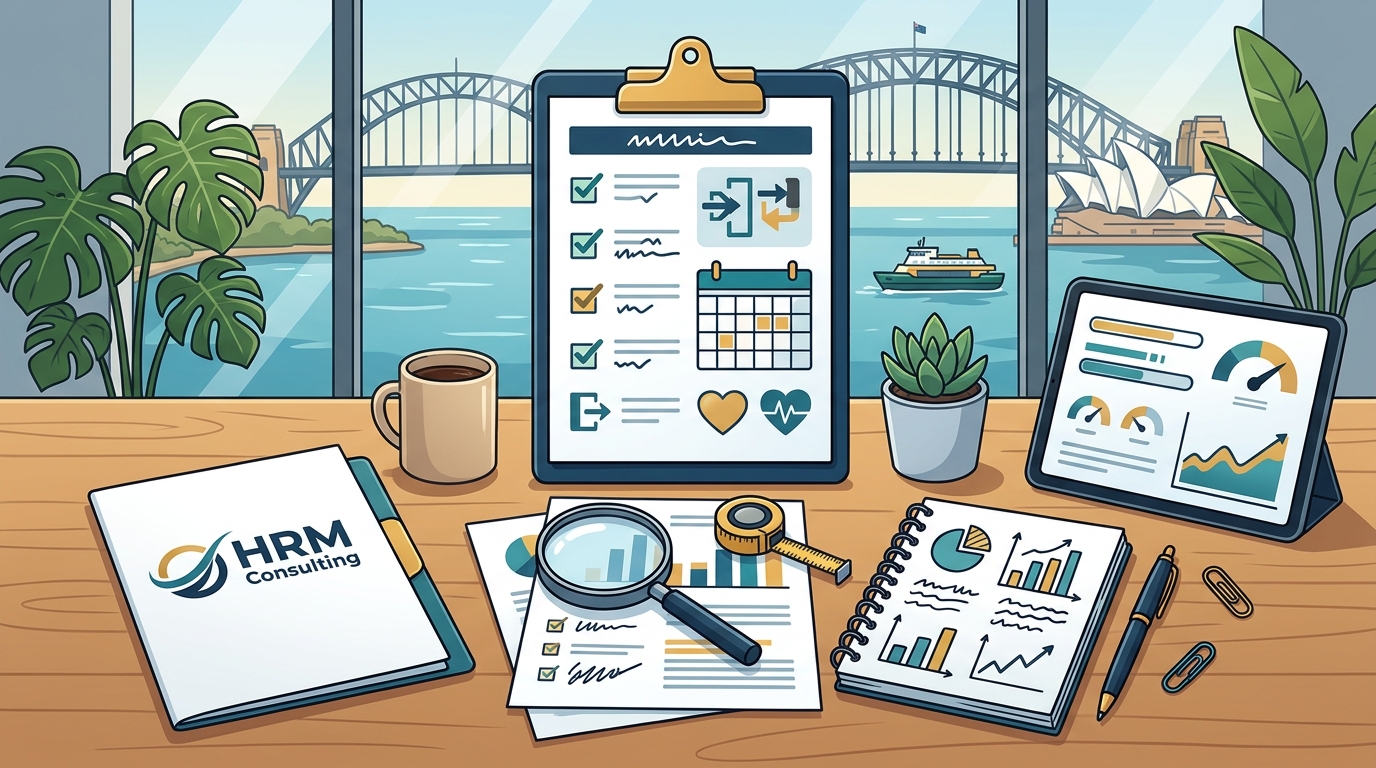
Measuring employee engagement in a Sydney business requires tracking both sentiment and behavior. You should monitor pulse surveys, voluntary turnover rates, and absenteeism. These metrics reveal whether your workforce is committed or merely present. HRM Consulting helps Australian organizations align these data points with strategic goals. For additional details, review the HRM Consulting homepage.
What is employee engagement and why does it matter?
Employee engagement is the emotional and intellectual commitment an employee has to their work and the organization. It is distinct from job satisfaction, which is a passive state. Engagement drives productivity, innovation, and retention. In a competitive Sydney labor market, high engagement reduces the cost of frequent hiring.
The difference between satisfaction and engagement
Job satisfaction is a measure of how content an employee is with their current role. Engagement is a measure of how much effort an employee puts into their role. An employee can be satisfied but disengaged. They do the minimum required to keep their job. This distinction is critical for accurate measurement.
Which metrics should I track to gauge engagement?
Quantitative indicators of engagement
Voluntary turnover is the rate at which employees leave the company of their own accord. High voluntary turnover often signals low engagement. Absenteeism is the frequency of unplanned absences. While some absences are due to health issues, a sudden spike can indicate burnout or disengagement. You should track these metrics by department to identify specific problem areas.
Qualitative indicators of engagement
Pulse surveys are short, frequent questionnaires that measure sentiment. They are more effective than annual surveys because they capture real-time feedback. Focus groups allow for deeper discussion of specific issues. Exit interviews provide insights into why employees leave. Combining these qualitative methods with quantitative data gives a complete picture.
How do I design an effective engagement survey?
An effective survey is short, anonymous, and action-oriented. It should ask questions that can be acted upon. Avoid vague questions that do not lead to specific changes. The survey should measure key drivers of engagement, such as leadership, growth, and recognition. Keep the survey to no more than ten questions to ensure high response rates.
Key questions to include
Ask about the clarity of goals. Employees should know what is expected of them. Ask about the quality of leadership. Employees should feel supported by their managers. Ask about opportunities for growth. Employees should see a future within the organization. These questions address the core drivers of engagement.
Ensuring anonymity and trust
Employees will only answer honestly if they trust the process. Guarantee anonymity in the survey design. Communicate clearly how the data will be used. Share the results with the team. Outline the actions you will take based on the feedback. This builds trust and encourages participation in future surveys.
What role does leadership play in engagement measurement?
Leadership is the primary driver of employee engagement. Managers are the first point of contact for employees. Their behavior directly impacts team sentiment. Measuring engagement without involving leadership is ineffective. Leaders must be trained to interpret data and act on it. They must also be held accountable for their team's engagement scores.
Manager accountability and feedback
How do I turn engagement data into action?
Data without action is useless. Employees will disengage further if they see no change after a survey. You must create a clear action plan based on the data. Prioritize the most critical issues. Assign ownership for each action. Set deadlines for implementation. Communicate the plan to the entire organization. This demonstrates that the company is committed to improvement.
Creating a sustainable engagement strategy
Engagement is not a one-time project. It is an ongoing process. You should review engagement metrics quarterly. Adjust your strategies based on the results. Celebrate successes. Learn from failures. This creates a sustainable culture of engagement. It also ensures that the organization remains adaptable to changing conditions.
Key Takeaways
- Employee engagement is distinct from job satisfaction and drives performance.
- Track both quantitative metrics like turnover and qualitative data like surveys.
- Design surveys that are short, anonymous, and action-oriented.
- Involve leadership in interpreting data and driving change.
- Turn data into action by creating clear, owned action plans.
- Review metrics regularly to maintain a sustainable engagement culture.
Frequently Asked Questions
How often should I conduct engagement surveys?
You should conduct pulse surveys quarterly or bi-monthly. Annual surveys are too infrequent to capture real-time sentiment. Pulse surveys allow you to track trends and respond quickly to changes. They also keep employees engaged in the process. The frequency should depend on the size of your organization and the pace of change.
What is a good engagement score?
There is no universal standard for a good engagement score. It depends on your industry and baseline. Focus on improving your score over time. Compare your score to industry benchmarks if available. The trend is more important than the absolute number. A rising score indicates positive progress.
How do I handle low engagement scores?
Investigate the root causes of low scores. Talk to employees to understand their concerns. Create an action plan to address the issues. Communicate the plan to the team. Follow up on the actions taken. This shows employees that their feedback is valued. It also helps to rebuild trust and improve engagement.
Partner with HRM Consulting for Strategic HR Solutions
Measuring and improving employee engagement is a complex task. It requires expertise in data analysis, leadership development, and organizational design. HRM Consulting provides tailored HR solutions for Australian businesses. We help you align your human capital strategy with your corporate goals. To plan your visit, contact our team. Learn more: hrmconsulting com au.